BD Research Cloud
Built for BD Biosciences
Pioneered an algorithm that reduced a 30-minute expert process to under 2 minutes. BD patented the result.
This is the project I’m most proud of, and I can’t show you the code.
BD Biosciences makes flow cytometers, instruments that analyze cells by shooting them through a laser beam and measuring the light that bounces back. If that sentence didn’t mean much to you, that’s roughly where I started too.
What I Built
Research Cloud is a full multi-tenant collaboration platform for flow cytometry researchers. The organization hierarchy has users, groups, and labs. Labs own cytometer configurations; groups own experiments, workflows, and data.
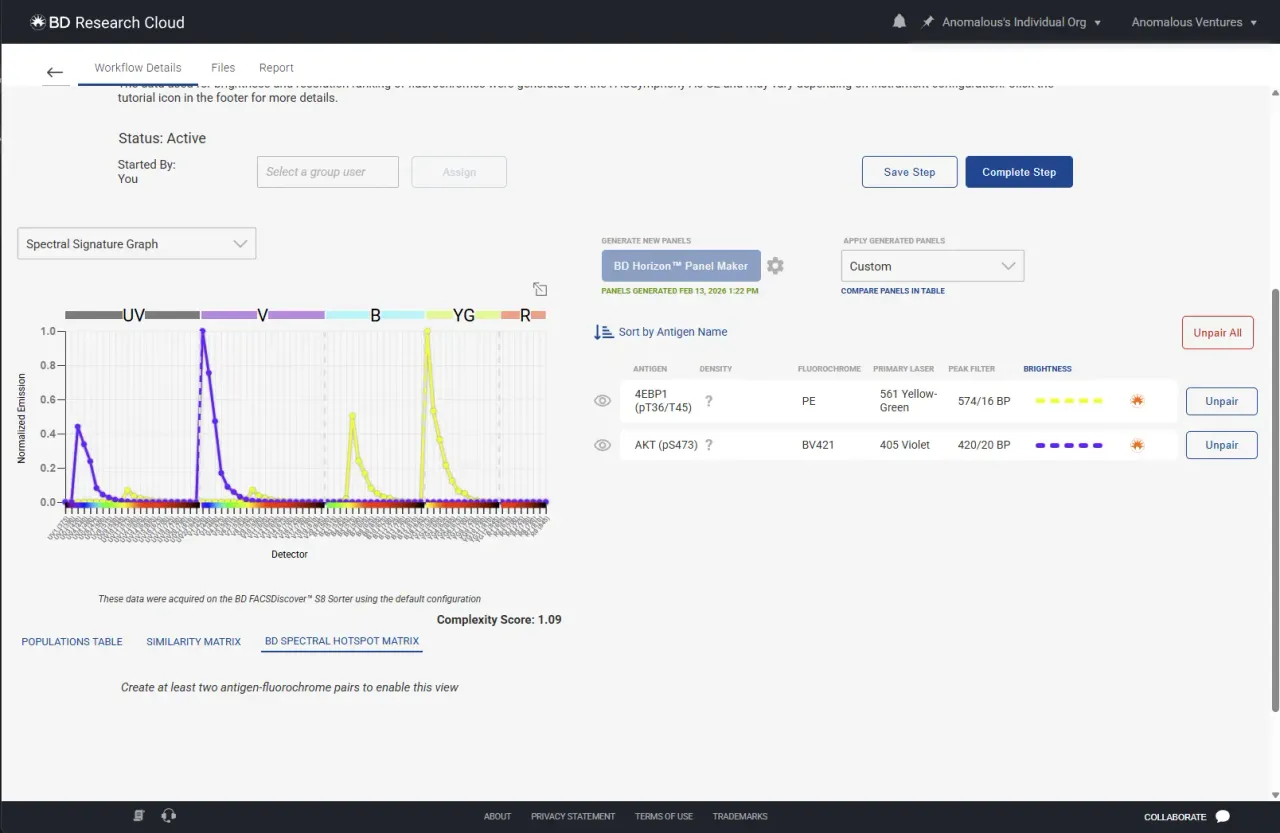
The major feature is the BD Horizon Panel Maker algorithm. Flow cytometry experiments require assigning fluorochromes to antigens (mapping labels to the things you’re trying to detect). Doing this well means minimizing spectral spillover, accounting for antigen density and co-expression data, and working within the constraints of a specific cytometer configuration. An experienced researcher can build a panel in about 30 minutes. The algorithm I wrote does it in under two.
The core approach is a novel application of well-established computer science. The panel design problem closely resembles the N-Queens constraint satisfaction problem, so I built the initial solver around the Min-Conflicts algorithm. Later, working with BD’s scientists, we added a genetic algorithm step that evolves candidate panels to escape local minima and find better solutions than any single solver pass would produce. The final version returns up to three panel suggestions with comparison metrics so researchers can evaluate tradeoffs.
BD filed a patent on the algorithm.
The Full Platform
Beyond panel design, Research Cloud handles experiment creation for BD FACSDiva cytometers (exports instrument-ready XML), cytometer configuration management, reagent inventory tracking, data management with FlowJo integration, spectrum visualization, similarity/complexity/hotspot matrix analysis, and real-time messaging for researcher collaboration across organizations.
My Role
I started as Lead Frontend Developer and Innovation Engineer, then moved to Software Development Manager. I led scrum ceremonies, gathered requirements from researchers and product stakeholders, built the React/Redux frontend, and created the patented algorithm. This was September 2019 through August 2021.
The domain-crossing is the part I find most interesting about consulting. Walking into a field you know nothing about, learning enough to build something genuinely useful, and having the client decide it’s worth protecting with a patent.